

How long does digital marketing take to work? A digital marketing timeline for a small business depends on the channel, the starting condition, the sales cycle, and what “work” means. Paid advertising can generate useful signals quickly, while organic search and authority building usually need sustained improvement and evaluation. Neither should be judged only by traffic.
Quick answer
Expect early operational signals in the first few weeks, clearer channel evidence in roughly 30 to 90 days, and a stronger view of compounding work such as SEO and content over several months. These are review windows, not guarantees. A business with weak tracking, unclear offers, or a broken contact path may need foundation work before any channel can produce trustworthy results.
TLDR
- Define success as qualified inquiries or another business outcome before choosing a timeline.
- Paid campaigns can produce data quickly, but useful optimization still needs enough conversions and sales feedback.
- SEO and content usually require months of consistent, people-first improvement.
- Website and tracking fixes can show immediate technical changes, but commercial impact needs real visitor behavior.
- Review at 30, 90, and 180 days instead of demanding a guaranteed date.
Digital marketing timeline by channel
A local clinic with existing demand and a clear booking path is not starting from the same position as a new business with no search history, weak service pages, and an untested offer. The channel may be identical, but the evidence available for decisions is different.
Timeline estimates should consider:
- Existing brand and search demand
- Website quality and conversion path
- Offer clarity and competitiveness
- Geographic market and audience size
- Budget and media volume
- Sales cycle length
- Tracking reliability
- Approval speed and content capacity
The digital marketing audit guide can help establish that starting point.
So, when someone asks how long does digital marketing take to work, the answer should separate channel speed from the time needed to confirm lead quality and business impact.
What does “working” mean?
Teams often use the word too loosely. A campaign can generate impressions without relevant visitors, clicks without inquiries, inquiries without fit, or qualified leads that take months to become customers.
Choose a primary result and the supporting signals that lead to it. For example:
- Primary result: qualified consultation requests
- Supporting signals: relevant query impressions, service-page visits, completed forms, answered calls, booked appointments, and sales-qualified lead feedback
This prevents a channel from being declared successful because one easy metric increased.
Digital marketing timeline for paid advertising
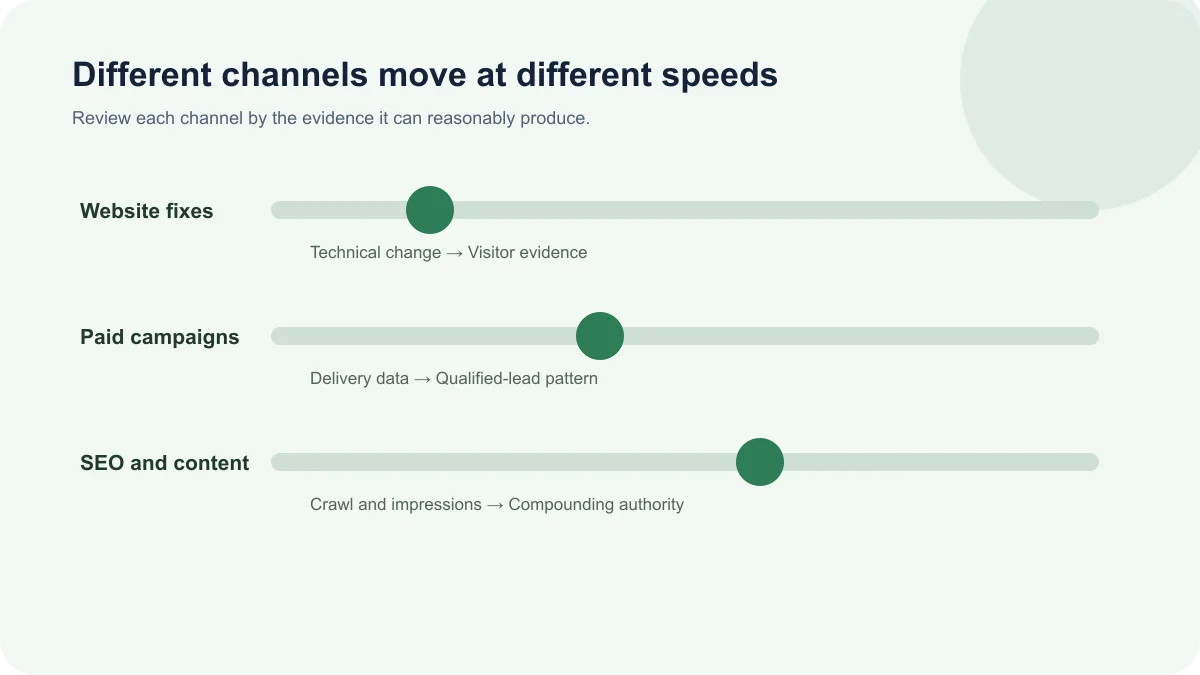
Paid search and social campaigns can begin delivering impressions and clicks soon after approval and launch. That does not mean the campaign is optimized. Early data can reveal whether ads are serving, whether users respond, and whether landing pages function. It may not yet reveal stable cost per qualified inquiry.
The first phase should verify:
- Search terms or audiences are relevant
- Ads and landing pages make the same promise
- Calls, forms, messages, and bookings are tracked correctly
- Spam and low-quality inquiries are separated
- The sales team records what happened after the lead arrived
If a form fires an analytics event but the lead never reaches the CRM, the campaign does not have reliable conversion evidence. Use the GA4 contact-form measurement checklist to test the complete path.
Digital marketing timeline for SEO
SEO is a compounding process rather than a fixed waiting period. Technical corrections may be crawled quickly, but Google must still revisit pages, process changes, compare usefulness, and observe the wider site over time. Competition and existing authority also matter.
Google’s official core update guidance says improvements may take effect in a few days or may take several months, and that no change guarantees a noticeable search impact. That is a better expectation than a promise of page-one rankings by a specific date.
Useful checkpoints include:
- Indexability and crawlability
- Impressions for relevant queries
- Movement from low positions toward the first two result pages
- Better click-through rate after title and description changes
- Growth in internal and external authority signals
- Qualified inquiries from organic landing pages
How long does content marketing take?
Content needs time to be discovered, indexed, linked, and trusted. A single post may answer an urgent question and gain visibility quickly, but a durable content program depends on topic coverage, internal linking, originality, and usefulness.
Publishing more frequently does not automatically shorten the timeline. Five overlapping articles can divide signals and create maintenance work. One strong article that fills a real gap, supports a service page, and receives relevant internal links is often a better investment.
Can website changes work immediately?
Some technical outcomes are immediate. A repaired form can start delivering messages as soon as it is fixed. A clearer CTA can be visible at once. A redirect can eliminate a dead path immediately.
Business impact still requires observation. Enough relevant visitors need to reach the page, notice the change, and take action. For a lower-traffic business, it may take longer to gather meaningful evidence even when the improvement is sound.
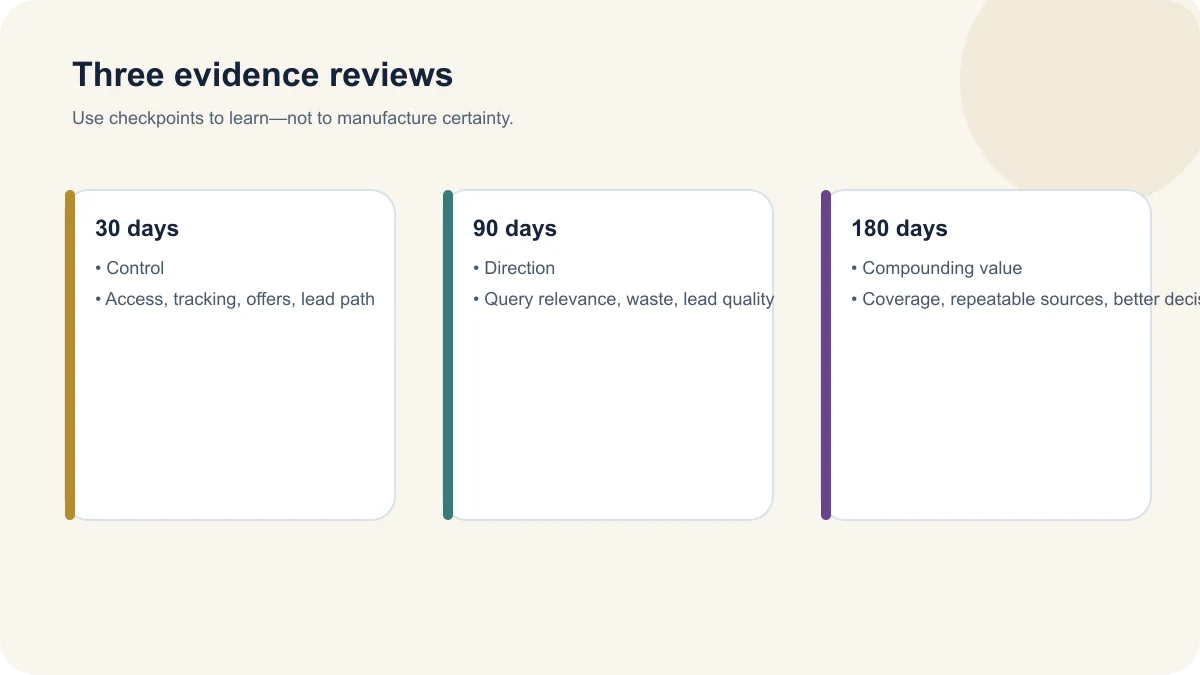
Digital marketing timeline: a 30-, 90-, and 180-day review
First 30 days: establish control
Confirm account ownership, tracking, baseline performance, key pages, offers, lead definitions, and obvious conversion failures. Launch only the work that has a clear owner and measurement path.
By 90 days: evaluate direction
Review query relevance, campaign waste, content discovery, landing-page behavior, lead quality, and operating bottlenecks. Decide what deserves more investment and what should be corrected or stopped.
By 180 days: assess compounding value
Look for stronger organic coverage, repeated lead sources, improved conversion paths, more reliable reporting, and a clearer relationship between marketing activity and sales conversations. Compare outcomes with the baseline, not with a promise made before the work began.
Digital marketing timeline delays
Common delays include slow approvals, missing account access, unclear offers, weak landing pages, inconsistent budgets, broken tracking, low search demand, poor lead follow-up, and changing priorities before enough evidence exists.
Another risk is treating every channel as a separate project. Search, website content, reviews, paid campaigns, and lead handling affect one another. A coordinated Digital Marketing service should make those dependencies visible.
Questions to ask a marketing provider about timelines
- Which early signals should appear first?
- What assumptions does the estimate depend on?
- How will qualified leads be distinguished from raw conversions?
- When will we stop or change a weak tactic?
- Which results are within the provider’s control?
- What does our team need to deliver on time?
- How will SEO, paid media, the website, and sales follow-up be reviewed together?
Frequently asked questions
Can digital marketing work in one month?
It can produce useful early data and sometimes inquiries within a month, especially through paid channels or a strong existing audience. One month is rarely enough to judge a complete long-term program.
Why do agencies ask for several months?
Some channels need time to accumulate data and authority. A longer term should still include clear milestones, reporting, accountability, and exit conditions rather than becoming an excuse for vague work.
How do I know whether slow results are normal?
Compare actual leading indicators with the agreed plan. If tracking is working, relevant visibility is improving, tests are documented, and lead quality is reviewed, there is evidence of progress. If reporting shows only activity, investigate.
Should I stop SEO if paid ads generate leads faster?
Not automatically. Paid ads and SEO solve different timing and coverage problems. The right mix depends on margins, demand, competition, landing-page readiness, and how quickly the business needs evidence.
What is the most important first step?
Define the customer, offer, qualified action, baseline, and full path from discovery to contact. Without that foundation, speed is difficult to interpret.
Replace promises with reviewable evidence
The better question is not “When will marketing work?” It is “What should we be able to verify at each stage?” That shift protects the budget and creates a more useful relationship with any provider.
Start with a Digital Visibility Diagnostic to identify the strongest first move and set honest review points for your business.