
Can AI search fewer clicks and still create business value? Sometimes. A generated answer can resolve part of a question before the user visits a website, while still introducing a brand, shaping a shortlist, or prompting a later branded search. But fewer clicks can also expose weak positioning, commodity content, or an unclear reason to visit. Businesses need evidence that separates useful visibility from comfortable excuses.
AI search fewer clicks: quick answer
Do not judge AI visibility by click-through rate alone. Review which pages appear, the type of query, branded-search changes, engaged landing-page visits, assisted conversions, and qualified enquiries. Then improve the page’s unique evidence and next step. An impression is useful only when it reaches the right audience and contributes to a measurable business path.
TL;DR
- AI answers can satisfy simple information needs without a website visit.
- Fewer clicks are not automatically success or failure.
- Commodity summaries give users little reason to visit the source.
- Original evidence, tools, examples, and clear service relevance create stronger visit intent.
- Measure qualified actions and branded demand alongside impressions.
- Diagnose query intent before rewriting content.

Why AI visibility may not produce the old click pattern
Traditional search results often required a visit to obtain the answer. Generative search features can summarize several sources, present steps, or compare options directly on the results page. A user may continue exploring without clicking every cited page.
That changes the path, but it does not remove the need for authoritative sources, trusted businesses, and useful destinations. People still need providers, original evidence, tools, local details, pricing context, implementation help, and a way to act.
The strategic question becomes: what does the page offer after the summary?
Separate informational visibility from buying intent
A broad definition such as “What is SEO?” may earn many impressions with low visit urgency. A comparison, calculator, implementation checklist, local requirement, or provider-selection guide can create a stronger reason to continue.
Classify appearing pages by intent:
- definition and discovery;
- problem diagnosis;
- comparison and evaluation;
- implementation;
- local or industry-specific requirement;
- service and provider selection.
Compare click and conversion behavior within similar intent groups. A low click rate on an informational definition should not be judged against a service page viewed by buyers with an immediate problem.
Look for evidence of assisted discovery
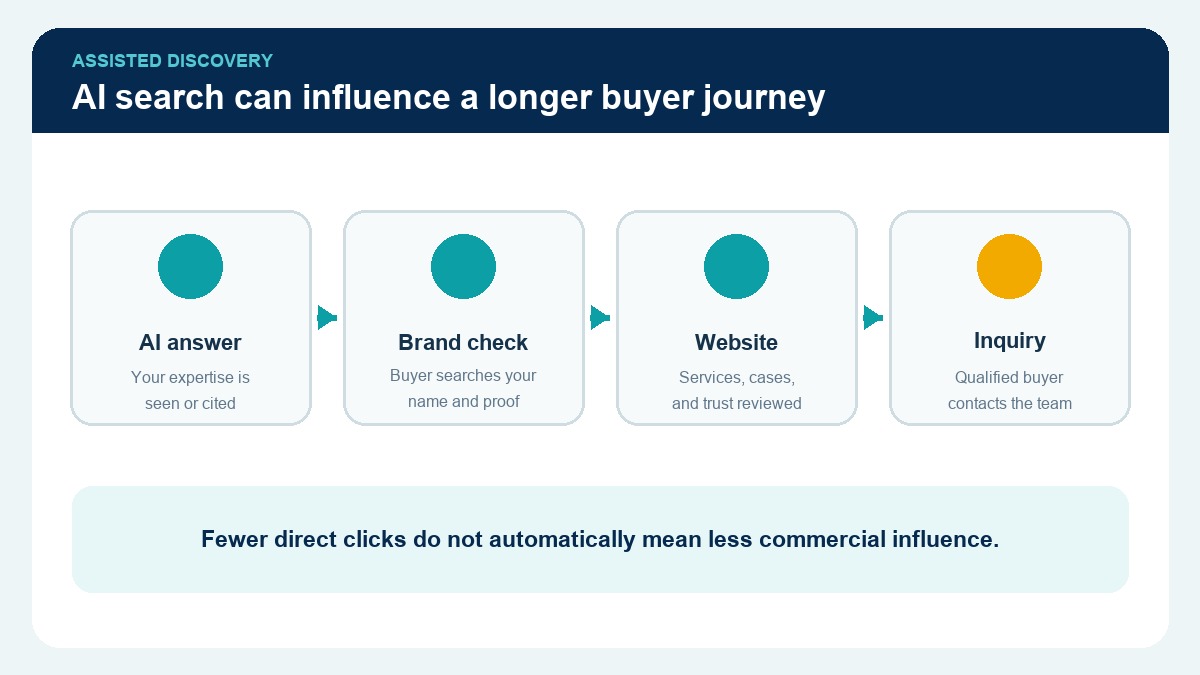
A person may see RightJob Solutions in an AI answer and later search the company name, open a social profile, revisit from another device, or ask a colleague to investigate. These paths are difficult to attribute perfectly.
Use supporting signals:
- branded Search impressions and clicks;
- direct and returning visits;
- landing-page assists before an enquiry;
- consultation forms that mention the guide or topic;
- sales-call questions matching the content;
- target-country visibility;
- changes in qualified organic leads.
Treat these as evidence that strengthens or weakens a hypothesis. Do not label every increase in branded traffic as caused by AI search.
Give people a reason to visit
If the page only restates information available everywhere, a generated summary may be enough. Strengthen the destination with assets that cannot be reduced to a generic paragraph:
- original research or first-party observations;
- screenshots and step-by-step implementation evidence;
- downloadable checklists or templates;
- calculators and decision tools;
- case studies with credible constraints and outcomes;
- local requirements and service-area context;
- expert comparison criteria;
- clear ownership, author, and review information.
Google’s guidance for generative-AI features continues to emphasize useful, non-commodity content and established SEO foundations. Adding repetitive FAQ blocks or machine-generated variations is not a substitute for a page with genuine information gain.
Google’s description of its generative-AI performance reports also separates visibility analysis into pages, countries, devices, and trends. That reinforces the need to diagnose where exposure is changing before treating a sitewide click decline as one uniform problem.
Improve the search-to-page message match
Check the title, introduction, and first visible screen. They should confirm that the visitor has reached a page capable of solving the problem implied by the query.
Avoid hiding the useful answer below a long company introduction. Lead with the decision, limitation, or process. Then make the next step clear: compare options, use the checklist, view evidence, explore the service, or request an appropriate review.
If the page promises a checklist but delivers an essay, impressions may rise while engagement remains weak.
Measure the landing experience
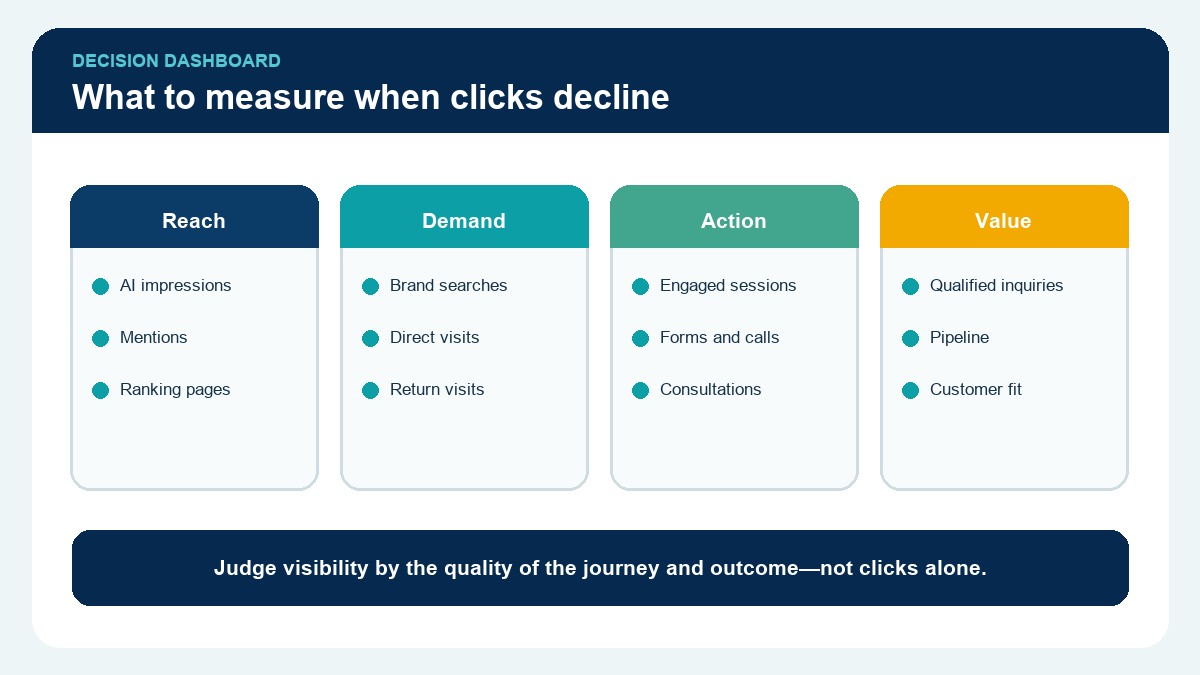
For pages appearing in AI search, review:
- engaged sessions;
- meaningful scroll or content interaction;
- internal clicks to relevant service pages;
- form starts and completions;
- phone, email, or booking actions;
- conversion rate by device and country;
- qualified-lead rate;
- recurring objections reported by sales.
Check technical experience too. Slow loading, intrusive popups, broken mobile forms, and unclear calls to action can waste the traffic the page does receive.
Decide whether to update, expand, or leave the page alone
Update the page when information is outdated, the promise does not match the answer, target-market context is missing, or qualified visitors cannot find the next step.
Expand it when the topic has a valuable adjacent question that deserves its own evidence or tool. Link the pieces clearly instead of forcing every intent into one enormous article.
Leave it alone when visibility and qualified outcomes are stable and the proposed change is based only on anxiety about a short-term click fluctuation. Continuous rewriting can erase useful signals and make measurement harder.
For a disciplined measurement approach, read our guide to AI search performance in Search Console and the AI search visibility checklist.
Frequently Asked Questions
Does appearing in an AI answer count as a ranking?
It is a form of visibility under the platform’s reporting rules, but it should not be translated into a conventional fixed ranking position without supporting data.
Are fewer organic clicks always caused by AI search?
No. Demand, seasonality, rankings, competitors, titles, technical issues, tracking changes, and search-result layouts can also affect clicks.
Should we block AI crawlers to protect traffic?
That is a strategic and technical decision with tradeoffs. Identify the specific crawler, product, content objective, and business consequence before changing access controls.
What content is most likely to earn a visit?
Content with original evidence, useful tools, local relevance, clear implementation detail, credible comparisons, or a service the user actually needs provides a stronger reason to continue.
Can RightJob Solutions audit AI-search visibility and conversions?
Yes. RightJob Solutions can review search reporting, content purpose, landing-page experience, analytics, and qualified-lead handoffs. Explore our digital marketing services or contact us.
Final takeaway
AI search can change how attention becomes a visit. The answer is not to celebrate impressions blindly or panic over every click decline.
Measure the full path, strengthen the information a summary cannot replace, and make the page useful to the qualified buyer who chooses to continue.
Editorial source note: AI feature presentation and Search Console reporting can change. Recheck Google’s current documentation during each quarterly performance review.